
My conversation with Jonah Lehrer:


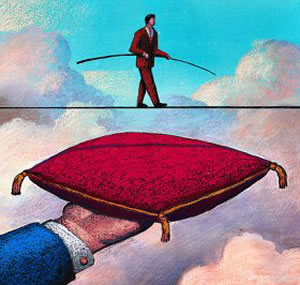
 edited by Wharton Risk Center Managing Director Erwann Michel-Kerjan.

 science writer Ethan Watters shows that we are not only changing the way the world understands and treats mental illness, but that we are actually trying to redefine the symptoms of others to fit into our own pharmacologically driven solutions. Good for big pharma, bad for diversity and human compassion.
 The outpouring of aid and support for Haiti has been overwhelming. It should make us wonder if we are somehow hardwired to be compassionate, empathic and altruistic. Over the past year, amidst the financial crisis, the ideas of Ayn Rand and the supposed virtues of selfishness have gained new converts. Yet more and more science tells us that compassion, far from being weak, is the very quality that has enabled the successful evolution of our species and will ultimately determine our fate.


 Janine Wedel is getting lots of attention for her book Shadow Elite: How the World's New Power Brokers Undermine Democracy, Government, and the Free Market. But is the attention justified? Has she simply taken the fundamental idea that there is a core group of talented and smart people, on both sides of the political equation, that move between government and the private sector and works hard to move their agenda's forward. From Kennedy's Harvard mafia to Reagan's California kitchen cabinet to Clinton's DLC advisor's to Obama's own search for the best and the brightest, there is absolutely nothing new about these practices. Advisors come and go with Presidents and administrations. We change administrations and we change advisors and cabinet members. In turn, the old advisors become a kind of shadow government. Think of the British system and their permanent shadow government. We don't have this, we have businesses and think tanks that serve a similar purpose. Yet Janine Wedel tries hard to make something sinister about this common practice.
 Both Oscar Wilde and later Arthur Miller talked about those who knew "the price of everything, and the value of nothing." In today's technologically driven desire for the "perfect market" this is perhaps more profound than ever. But is faith in the "perfect market" and in prices a real way of valuing the world? Are we taking into account the real costs of the things we consume? Does the current financial crises indicate that we have to recalibrate the relationship between markets and the underlying economy and do we need a new way to value the world's worth. These are the ambitious and provocative ideas taken up by activist and academic Raj Patel in his new book The Value of Nothing: How to Reshape Market Society and Redefine Democracy.
 A new year and a new decade, but many of the same old problems. In trying to face the complexity of problems and issues facing us in the 21st Century, sometimes we just can't figure out what problem we are solving. We get so caught up in our assessment or spin on the problem, that we loose site of what we're really trying to accomplish. Business professor Ian Mitroff, in his book Dirty Rotten Strategies: How We Trick Ourselves and Others into Solving the Wrong Problems Precisely argues that by focusing on the wrong problem, we usually make matters worse.
.jpg)
 Imagine how different so many aspects of our society and our economy would be if the whole idea of retirement and a "life plan" were ripped asunder. Timothy Ferriss argues that there is a new way to live, one more suitable for unpredictable economic times and one that provides for present-tense, day by day "luxury lifestyle design." Timothy Ferriss, one of Fast Company's "Most Innovate Business People," lays out the predicate for The 4-Hour Workweek.


 , he shows us once again, as he did in A Bright Shining Lie, that the great movements of history turn on the character and actions of individuals. He tells us a story of how we avoided Armageddon during the Cold War and in so doing he helps to instruct us in the importance of appreciating the military and some of its best and brightest, while making sure that we are not overtaken by an overzealous military juggernaut. With balance, insight and an appreciation for history, Sheehan tells us a vivid story for our times and for all times.


 As government attempts huge undertakings in healthcare, the environment, and the economy, how can we make sure that these often exciting plans will be followed through with effective execution. We have landed men on the moon, administered the Marshall Plan, created the Interstate Highway System and achieved victory in World War II. Yet today we look at government through the lens of Vietnam, The Iraq war, Hurricane Katrina and Challenger. What happened? How has government lost it's mojo? William Eggers, Global Director for Deloitte's public sector industry research program looks at this dilemma in his new work If We Can Put a Man on the Moon: Getting Big Things Done in Government.
 More than at any other time since the Enlightenment, we fear science as much as we embrace it. Our technical and scientific capabilities have brought the world to a turning point, in which accomplishments clash with expectations, resulting in a kind of cultural schizophrenia. We expect miracles, but have lost faith in the scientists, doctors and other experts capable of producing them. From this contradiction emerges what New Yorker staff writer Michael Specter has written about in his book Denialism: How Irrational Thinking Hinders Scientific Progress, Harms the Planet, and Threatens Our Lives. The rejection of reality in favor of a more easily acceptable lie. It is a dangerous phenomenon, a contagious one, one fueled by the fear of change. Where we once celebrated scientific achievement, we now live in a world where denialists wage a war against progress.