Wednesday, September 28, 2022

We Live in a Golden Age of Ignorance: A conversation with Andy Borowitz

Look at the British press most days, and you’ll find that the government and the royals are being skewered and made fun of. The Brits have a long tradition of publicly calling out their leaders for absurdity, stupidity or embarrassing behavior. In America, it seems that part of the population almost embraces this kind of behavior; that rather than calling it out, it votes for it.

It celebrates it on talk radio and on Fox. Imagine an entire portion of the electorate for whom ignorance is bliss. What we do have, however, is a healthy tradition of satire but almost entirely on the left. Historically, from the likes of Will Rogers or H.L. Mencken or Ambrose Bierce and in more contemporary times, folks like Mort Sahl and Lenny Bruce and Jon Stewart, Stephen Colbert, Al Franken and Andy Borowitz.

Andy is an award-winning comedian, a New York Times bestselling author, a graduate of Harvard College, where he became president of The Harvard Lampoon, and in 1998, he began contributing humor to The New Yorker‘s Shouts & Murmurs and Talk of the Town column. And in 2001, he created The Borowitz Report, a satirical news column that’s must reading for anyone that cares about the country. His newest book is Profiles in Ignorance: How America’s Politicians Got Dumb and Dumber.

My WhoWhatWhy conversation with Andy Borowitz:: 


Wednesday, September 14, 2022

Harvard Is Once Again The Center of Psychedelics: A Conversation with Patrick Schmidt

If our current era is one of politics, technology, and economics, it's fair to say that the 60s were an era where social science, self-reflection and cultural anthropology ruled the day.


And if places like Stanford, and MIT are the intellectual hubs of our day, Harvard was an intellectual hub of the ’60s


Nowhere was that more true than in Harvard's establishment of a Department of Social Relations.  With figures like Timothy Leary, Ram Das, and Ted Kaczynski, as part of the faculty, it was an epicenter of its time.


Today Harvard is restarting psilocybin reaching and launching a new center for the neuroscience of psychedelics in association with Mass. General Hospital.  So it’s a good time to look back at the antecedents of this effort.


Patrick Schmidt has written about it in his new book HARVARD’S QUIXOTIC PURSUIT OF A NEW SCIENCE.


My conversation with Patrick Schmidt:


Tuesday, August 30, 2022

The End of American Competitiveness: A Conversation with Michael Mazarr

For much of our 246 years, we were a young, dynamic, striving country. Sure, we had flaws, we made mistakes, we took wrong turns, but we believed deeply in our ability to learn from those mistakes and to move the country forward. Today, it seems that we’re caught between that young, energetic country and some of the more mature, but less dynamic nations we see in Europe, for example. We are like a mean, angry adolescent nation ready to fight with anyone and about anything.
When the James Dean character in Rebel Without a Cause was asked, “What are you rebelling against, Johnny?” The answer was, “What do you got?” We are like that adolescent. Some are rebelling against our founders, some against our institutions, against our diversity, our technology. Essentially, what do you got? Like any adolescent, maybe we will outgrow this, or will there be enough time before we destroy the very fabric of our democracy? We’re living in a high school lunchroom with cliques, and anger, and hormones, and guns, and bravado. We’ll either graduate to the next level, or we’ll take the world’s longest time out while China and the rest of the world pass us by.

We’re going to talk about the state of the nation today with Michael J. Mazarr

Michael is a senior political scientist at Rand, where he's the author of a recent Rand report entitled The Societal Foundations of National Competitiveness.

My WhoWhatWhy conversation with Michael Mazarr:


Tuesday, August 23, 2022

How Did The Pandemic Change Us? A Conversation with Katie Hafner


Early on in the pandemic, in the earliest days of the lockdown, we wondered how this was going to change the world. Ironically, it was easier to look out and to try and figure out its impact on the world, rather than dig deeper and wonder how it might affect us.

But it did give us time to think, to wonder, and for some, to be deeply creative. It gave us all a springboard to see the familiar in new ways. To cope with isolation in new ways, to reaffirm or reconstruct our most intimate relationships.

All of this has given way to what might become a new genre of the pandemic art form; be it in the service of art, or music, or movies, or novels.

If Katie Hafner's debut novel The Boys is any indication, it will be a great genre.

My conversation with Katie Hafner: 


Wednesday, August 10, 2022

Why Harvey Weinstein Should Matter: A Conversation with Ken Auletta

In spite of the supposed transparency of the internet age, more and more we live in the age of complicity. Last month we saw it with the trove of documents and stories that came to light about UBER. Tim Miller’s recent book about Trump's enablers shows how it’s happened repeatedly in the White House, just as Michel Lewis showed us, several years ago, how it happened on Wall Street in the face of the 2008 financial crisis.

For 20 years in Hollywood, the complicity around the actions of Harvey Weinstein was airtight.

What is it about Hollywood and Wall Street and politics that encourages and even condones such complicity in bad behavior?

Long-time media journalist Ken Auletta tells the thirty-thousand-foot view in telling the story of Harvey Weinstein, his rise and fall, through the lens of his enablers and his victims in his new book Hollywood Ending: Harvey Weinstein and the Culture of Silence.

My conversation with Ken Auletta:
 

Monday, August 1, 2022

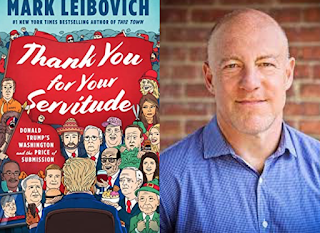
The Trump Roster of Toadies: A conversation with Mark Leibovich

Screen%20Shot%202022-07-27%20at%203.09.45%20PM.pngModern Washington has always offered up an impressive roster of toadies. Yet the Trump administration seems to have offered us a unique period of bowing and scraping.
 
Historically, sucking up takes a variety of forms, from pretty compliments to cloying flattery and outright treachery. But it doesn't stop there. The kind of sycophant we see from those in the GOP, combines other attributes like hypocrisy, lying, and manipulation. 
 
Throughout history we’ve certainly seen our share of sycophants; from the courts of Caligula to Dickens' Uriah Heep. 
 
We certainly get to see a lot of this in Mark Leibovich's new book Thank You For Your Servitude 
 
My conversation with Mark Leibovich:

Monday, June 27, 2022

Another Love Discouse: A Conversation with Edie Meidav

Sometimes the world makes little sense. That’s why when the right novel comes along, it helps us to look inward at the things that really shape us, move us and help carry us into tomorrow.

For a time, amidst the dark days of the pandemic, there was a precariousness about life itself. When we felt more confident of coming out of that, it gave way to an equal uncertainty about our most intimate relationships. It opened a pandora's box, letting out our grief and fear and inadequacies.

This is some of the stuff of Edie Meidav's new novel Another Love Discourse.

My conversation with Edie Meidav:


Tuesday, June 21, 2022

David Gergen on How Great Leaders are Made


We often look at leadership today as about celebrity or attention. In a time when we have elected a reality show star as President, when celebrity politics is the lifeblood of the American political class, it’s hard to imagine world class a politician or global leader emerging today

It makes you wonder, Is there something in our culture that has become antithetical to leadership? We watch Valdamer Zalinsky in wartime, and we’ve seen the leadership qualities that are possible. We even see it in some of our military leaders…but why the seemingly dearth of political leaders today.

David Gergen, who has devoted more than half a century of public service, and has served as a White House adviser to four US presidents of both parties: Nixon, Ford, Reagan, and Clinton, examines the perils of leadership in his new book Hearts Touched with Fire: How Great Leaders are Made.

My conversation with David Gergen:
 

Tuesday, June 7, 2022

Why Anxiety is Good for You!

It seems we live in a society where everyone wants to be protected. We don’t want to hear views we disagree with for fear that it might upset us, we don't’ want to go back to the office because we get stressed by a commute. We are afraid to let our kids go out and play unless they are supervised. We are anxious about money, about politics, about family…it’s no wonder there is an entire drug industry with provides for our every anxious moment.

We live emerged in first world problems that pale compared to the Greatest Generation, that fought a World War, lived through a Depression and did duck-and-cover drills in fear of nuclear annihilation.

Just maybe the fault is not in our society but in ourselves. Maybe instead of trying to eliminate all that might make us anxious, suppose we just got better at dealing with it. Just Maybe coping has fewer side effects than medication? Maybe that is what we were trained to do, as man first stepped onto the savannah, and the lion came after him. He learned very quickly to cope with anxiety. That coping is still buried somewhere in our DNA

This is where Tracy Dennis-Tiwary takes us in her new book Future Tense - Why Anxiety Is Good for You.

My conversation with Tracy Dennis-Tiwary:: 


Monday, May 23, 2022

Another Way Forward for Democrats

Back in 2002 in the wake of the George W. Bush election political demographer Ruy Teixeira, along with journalist John Judas, wrote The Emerging Democratic Majority. It spoke of the changing demographics of America. It looked at ethic diversity and how it was destined to forever shape Democratic success in the 21st century. This has not worked out so well for a multitude of reasons.

It turns out that the feature, not the bug, was the way our constitution was written. Rural voters matter.

Books like Hillbilly Elegy, What’s The Matter with Kansas and Kevin Phillips’ Emerging Republican Majority, painted a different picture than Teixeira and Judas. One where rural votes would succumb to the seduction of populism, culture wars and the power of the evangelical right. Enter Donald Trump and his collection of populist crazies.

But is this a permanent condition? Is this the real 21st century political future? Main State Senator Chloe Maxmin and her campaign manager Canyon Woodward think there is another way forward for the Democratic Party. They detail it in their book Dirt Road Revival.

My conversation with Sen. Chloe Maxmin and Canyon Woodward: 


Sunday, May 15, 2022

How Wars End: A conversation with Gideon Rose

Gabriel Garcia Marquez famously said that it’s much easier to start a war than it is to end it. Certainly, we’ve seen this up close and personal in Korea, Vietnam, Iraq, Afghanistan, and even, if we look more closely at the history, both world wars. It’s difficult to lose a war, but just as difficult to win, since winning a war is certainly not the same as winning the peace.

We see often in the corporate world that the founders of companies may be great at startups, but not so good at running mature companies. War is not that different. Those that start them, that direct them, and sometimes even win them may not be so good at ending them in a way that cements or makes worthwhile any victory. All these are important things to think about in the crucible of Ukraine, because someday this war will also end and whether it will be worth the loss of lives and treasure for the Ukrainian people or for Russia is certainly an open question.

It’s hard to imagine that either side is thinking about that endgame at this point, but certainly, they should be, at least according to my guest on this WhoWhatWhy podcast, former Foreign Policy editor and currently a fellow at CFR Gideon Rose.

My WhoWhatWhy conversation with Gideon Rose:


Friday, May 6, 2022

The Misinformation, Censorship and Noise That The Pandemic Gave Us: A Conversation with Joel Simon


While everyone is busy opining on the unknown and probably minor impact of a change of ownership of Twitter, we have literally ignored the chilling and perhaps long-term impact that the pandemic has had in enhancing government misinformation, curtailing free speech, and giving more powers to government. All while censuring information that actually might have helped people. And not just in China…but in the U.S. and around the world.

It was Churchill who originally said, “never let a good crisis go to waste.” Certainly, governments of the world did not. In China, Israel, Brazil, Egypt India, and int the US Covid-19 gave carte balance to leaders to misinform, misdirect and take political advantage.

Joel Simon writes in The Infodemic that throughout the pandemic many people felt as if they were drowning in information, yet in fact, they were being censored.

My conversation with Joel Simon: 


Thursday, April 28, 2022

Why the Internet Is Less Safe Than Flying or Driving or Eating: A Conversation with Bruce Schneier

The metaverse notwithstanding, the nexus between what happens on the internet, and what happens in the real, physical world, is disappearing. The blood-brain barrier between the two has broken. And every day, in our finances, in our interpersonal communications, in our entertainment, in our transportation, and even in what we eat, the connection between our digital world and our real world is further integrated.

Reactions to this vary from, “I’m terrified of everything; the government should control the internet,” to, “There is no privacy; do I have nothing to hide; and why should I care if I’m being served up greater convenience?” The fact is that vast sums of data on all of us are being collected, sometimes in the name of convenience, sometimes in the name of national security, and it’s unclear exactly what’s going on. It’s unclear where security theater starts, and real security begins.

In short, the cyber world presents 21st-century problems that have not yet been solved, much less, fully understood. We talk about that today with my guest, Bruce Schneier,  a public interest technologist working at the intersection of security, technology, and people. 


Wednesday, April 27, 2022

A Whistleblower Stands Up To China: A Conversation with Ashley Yablon


Think about how different the world is because of whistleblowers. Think about the impact of Daniel Ellsberg, Coleen Rowley, Sherron Watkins, Jeffery Weigand, and Karen Silkwood.

Each changed the trajectory of a company or a government for the better, and in doing so risked making their own lives so much worse.

So why do they do it? Why do some individuals put their own moral compass ahead of the risks of being a whistleblower?

Ashley Yablon might be able to answer some of these questions because he is a whistleblower. His information would have a profound impact on one of China’s largest technology companies. It would result in large fines for the company, but what impact did it really have, and was it worth what it cost Yablon?

Ashley Yablon joins me to discuss STANDING UP TO CHINA. 

My conversation with Ashley Yablon:

Monday, April 18, 2022

The Pandemic Profiteers: A Conversation with J. David McSwane


Even if the details were never reported in real-time, you knew instinctively during the chaos of the early days of the Pandemic, in the winter of 2020, that some people would get rich. Testing, PPE, Government loans, PPP, small business loans, and all overseen by Donald Trump and his cronies. What could possibly go wrong?

Obviously, a lot did go wrong. As a result, many died and many got rich. The pandemic in a way gave rise to a group of American oligarchs, many with a checkered history at best, who took advantage of both the inherent corruption and the blatant incompetence of the administration.

And yet the stage was set for it all, by mistakes over the years that were made by both political parties and even some politicians with better intentions.

Now, as the dust settles the story of what became Pandemic Inc. is being told by J. David McSwane. My conversation with David McSwane:

Thursday, April 14, 2022

Is Crypto a Libertarian Dream or a Left-Wing Nightmare? A Conversation with Daniel Pinchbeck

Cryptocurrencies, NFTs, Dows, and the blockchain they ride on are still, in the view of many, the decentralized financial instruments of the future. Even if they never replace the fiat currencies of nations, their roles in markets are here to stay.

And crypto, like everything else, has become politicized. You would think that an asset class that is almost pure speculation and not even about owning anything would be immune from the primal forces of partisanship. But no, both the left and the libertarian right have very different views of what crypto and its sister products on the blockchain and Web 3.0 should be.

Few have been harder than the left, who sees in it some kind of pure evil of the market. The good news is that when my guest — author, thinker, and all-around wiseman — Daniel Pinchbeck talks about the politics of crypto, he also helps us to understand what it really is, why it matters and why to the folks on all political sides it should matter in the future.

Daniel Pinchbeck has long been considered a Renaissance man and ahead of his time. He’s the author of the books Breaking Open the Head, The Return to Quetzalcoatl, Notes from the Edge of Time, How Soon is Now, and When Plants Dream. He saw around corners long before many others with respect to our ecological crisis and was a one-time executive director of the Center for Planetary Culture.

His essays and articles have appeared in every major publication. He’s spoken at conferences around the world and had his work featured in a 2010 documentary. He currently writes the Daniel Pinchbeck Newsletter on Substack. 

My WhoWhatWhy conversation with Daniel Pinchbeck:


Tuesday, March 22, 2022

Is the Journalism of Old Still Viable?: A Conversation with Brian Karem

For journalism, it may be the best of times and the worst of times. On the one hand the national media is more vibrant than ever before. The NYT, the Washington Post, the Wall Street Journal, as well as broadcast news and cable news networks are thriving, even amidst the post Trump drop in ratings.

For these outlets the transition to digital has been painful but successful. In other efforts, recurring revenue models are driving the success of independent news outlets as well as individual journalists on Substack and similar platforms. 


While romantics, like my guest Brian Karem rap quixotic about the 23 newspaper that once were available in New York, news websites and Twitter have now subsumed that, while new sites start up regularly with lower barriers to entry. In his new book Free The Press,


Brian Karem argues that journalism, particularly local journalism, is dying and that he has a specific, if very traditional formula to save it.

My conversation with Brian Karem:

Thursday, March 10, 2022

Corruption is America's Operating System: A Conversation with Sarah Chayes

Historian and journalist Sarah Chayes, argues that we can’t fix our floundering democracy until we face — and fix — our current levels of corruption.

In her view, we are in a “pandemic of corruption,” fostered by a network of corrupt businesses and political leaders worldwide. Before we can begin to set things right, however, we first have to grasp what modern-day corruption really is.

Behind this evolving crisis, says Chayes, is a shift in the very definition of power. Where society’s leaders once at least paid lip service to the concept of public service, today the only measure of social status, she contends, is money: The pursuit of power has turned into a no-holds-barred scramble for more and more wealth.

Chayes, the author of On Corruption in America, explains how we got here, and how we must build a coalition of integrity that transcends ideology, one that has its roots in equity and the public interest.


Tuesday, March 1, 2022

The Battle of Banks Not Tanks: A Conversation with Bill Browder

Beyond the minute-by-minute reporting of the ground war, the Twitter feeds, TickTock images, there are broader and more economically complex issues surrounding the war in the Ukraine, and the world’s response to it. Issues that include sanctions, the SWIFT system, and the seizure of assets, including yachts and private planes parked around the globe.

All part of the interconnectedness of a global economic structure that Russia, for better or worse, has been a part of. Few understand the intricacies of these connections better than Bill Browder. Years ago, Browder made millions in Putin’s Russia. What he didn’t know was what kind of price he would pay for getting involved in the ever-entangling web of Putin and his oligarchs.

The ultimate result was the brutal death of Browder’s lawyer and friend Sergei Magnitsky, who was murdered in prison after uncovering a multi-million dollar fraud committed by Russian government officials. Browder has carried on Magnitsky’s legacy, at great personal risk to himself. That legacy and the Magnitsky Act is a large part of the basis of the sanctions that we’ve been talking about.

Long before current events, Browder’s been leading a campaign to expose Russia’s endemic corruption and human rights abuses. He’s the author of the international bestseller Red Notice and the soon-to-be-published Freezing Order.


Monday, February 28, 2022

Recipe for Survival: A Conversation with Dana Ellis Hunnes:

All the way back in 1971, with the publication of Frances Moore Lappe’s Diet for Small Planet, the world began to take notice of the connection between what we eat, who we are, our environmental future, and the sustainability of our food supply.

Since then, the external forces that impact all of these things have brought more pressures to bear. The state of our climate and its consequences, the quality of our food, and how long we live are all going in the wrong direction. Even more problematic is that each seems to be siloed.

Dana Ellis Hunnes, in her new book, Recipe for Survival, takes a more modern and holistic approach in looking at ways to improve our health and at the same time improve the health of our planet.

My conversation with Dana Ellis Hunnes: :