Thursday, December 29, 2022

Art vs. Cable News: My Conversation with Amy Herman

In 2023, let us resolve to look at more art than cable news. Perhaps it is art, more than news, that will help us see around corners, solve problems and enhance our ability to see the world in a better way.

This approach has been the work of Amy Herman. Amy is the author of Fixed: How to Perfect the Fine Art of Problem Solving and the founder of the Art of Perception, a program that uses works of art to help people observe more closely, think more creatively and communicate more effectively.

My conversation with Amy Herman:

Wednesday, December 28, 2022

How Much HBO Did You Watch This Holiday Break? A conversation with Felix Gillette

From the days of beat up motels offering HBO as a special amenity to the metaphorical "creative destruction" of today, HBO has been a revolutionary force in entertainment and media. From its inception 50 years ago, HBO has been a pioneer in the blending of show and business. Disrupting television and paving the way for streaming, nonlinear programming, and more.  HBO is the ultimate example of the power of entertainment and story telling. 

In his new book It's Not TV: The Spectacular Rise, Revolution, and Future of HBO, Felix Gillette takes us through the remarkable history.  

My conversation with Felix Gillette:

Thursday, December 22, 2022

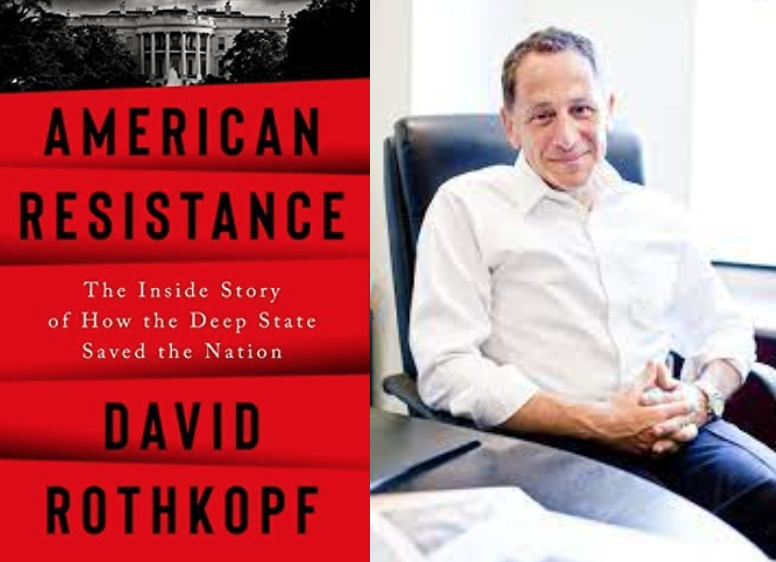
How Governance Was Saved During the Trump Years: A Conversation with David Rothkopf

While January 6th and the attempted coup may have been the final trigger at the end of the Trump presidency that could have brought down democracy, it was the four years prior that may have been the end of governance in America. The unsung heroes deep inside government, the departments, the cabinet secretaries, and the national security apparatus, all of whom took an oath to protect and defend the Constitution, may have been the ones who saved the Republic from its dismantling. All of this is laid out by David Rothkopf in his new book American Resistance.

My conversation with David Rothkopf:

Monday, December 19, 2022

The New Age of DNA Investigation: A Conversation with Edward Humes


Think of all the true crime stories you’ve watched or read. The image of a dogged or even sometimes fumbling detective usually lies at the center. But today, like almost everything else, technology has changed that.

Since the mid-80s, DNA technology has begun to transform the search for both guilt and innocence. Suddenly cold cases, like the Golden State Killer, are solvable, dozens and dozens of years later.

DNA databases are growing, as are privacy fears about their misuse. Dedicated cold case detectives, both professional and amateur, are evolving into a new profession.

The idea of no statutes of limitations on murder has always been a fundamental tenant of our criminal justice system. But now, with DNA’s ability to solve so many other types of crimes, will the system change?…Will the long arm of justice be forever.

That is what Pulitzer Prize-winning journalist Edward Humes examines in his new book THE FOREVER WITNESS.

My conversation with Ed Humes:

Thursday, December 8, 2022

Presidential Words Matter: My Conversation with Cody Keenan

Language has always been an important tool in American politics. It allows politicians to communicate their ideas and visions to their constituents and persuade them to support their policies. The power of words is so great that politicians often have teams of speechwriters to help craft their messages. These writers often work closely with the politicians to understand their vision and goals, and help express them in a way that resonates with the public.
In his book GRACE, Cody Keenan writes about his experiences as President Obama's chief speechwriter during a critical ten-day period in June 2015.

Through Keenan's perspective, we see the inner workings of the Obama administration and the challenges they faced in trying to pass legislation and shape the future of the country. His book offers a unique insight into the role of language in American politics and the way it can be used to shape history.

My conversation with Cody Keenan:

Wednesday, November 30, 2022

The Life and Death of Anthony Bourdain: A Conversation with Charles Leerhsen


Somewhere in the magic formula that makes great art is the internal potential for pain. Someone once said of artists that they were like the rest of us, except that their emotions were just always sitting closer to the surface…. more accessible, more sensitive, and more vulnerable to pain, despair, and even suicide.

The stories of people like Kurt Cobain, Van Gough, Virginia Woolf, Hemingway, Sylvia Plath, and Hunter Thompson, while all different, reinforce the image and reality of the tortured artist.

Add to this list, Anthony Bourdain. A complicated artist in so many ways, he would suffer a similar fate. But we should also remember that while all these stories have the same ending, each artist and their journey tells us more and more about ourselves and about the human condition.

This is the story that Charles Leerhsen tells in Down and Out in Paradise: The Life of Anthony Bourdain: 

My Conversation with Charles Leerhsen

Tuesday, November 22, 2022

When Legendary CEOs Can't Find a Successor: A Conversation with William Cohan

Herbert Hoover said that “the business of America is business.” And for decades no business better defined that than General Electric. An industrial titan, everything about it, from credit to jet engines, from x-ray machines to lighting the nation, to bringing entertainment to the masses, defined the broad shoulders of American business and American capitalism.

As might be expected, its executives also lived a good life. Like an episode of Succession, there were multiple private jets, cars always at the ready, and offices that make today's tech offices look provincial. There was the office staff waiting to fulfill every executive whim, and CEOs like Jack Welch and Jeffrey Immelt became household names and were seen on the covers of Fortune and BusinessWeek.

Today, after 130 years GE, like many companies of its time, has all but disappeared. Like so many corporate icons of that era, Polaroid, Kodak, Dow, and US Steel, we were led to believe that “creative destruction” took them down; that Clayton Christensen's Innovator's Dilemma had caught up with them.

But sometimes we discovered in hindsight that it was simply bad management, bad decisions, hubris, and the idle worship of what William James called the bitch goddess success that turned its ugly gaze on the company. This story, a cautionary tale about management men and money, is the story that best-selling author William Cohan tells in his latest book, Power Failure: The and Fall of An American Icon.

My conversation with William Cohan:

Thursday, November 17, 2022

War As A Nonviolent Struggle: A conversation with Thomas Ricks


Not just here in America, but throughout the world, the forces of liberty are battling the forces of authoritarianism. These forces are global as well as local.

Here in America such battles played out after George Floyd’s death, and on January 6th, and we still don’t know what might happen between now and 2024. These are moral battles for the soul and future of the country.

But hopeless as it may sometimes seem, these kinds of "against the odds" battles have been won before. The Civil Rights movement of the 1950s and 1960s, and even the anti Vietnam war movement were both, in their own way, successful. But why and how were they successful and what lessons do they provide us in today’s moral battles?

The Civil Rights movement was framed as a nonviolent struggle. Yet baked into that nonviolence were methods, tactics, training and communication from which we can all go to school.

Few understand the context of the battlefield and the military better than Pulitzer Prize winning journalist Thomas Ricks. In his new book Waging a Good War: A Military History of the Civil Rights Movement, 1954-1968 he details how the military tactics of the Civil Rights movement outshined even the US military.

My conversation with Tom Ricks:

Monday, November 7, 2022

Democracy Will Likely Be Voted Out on Tuesday: A Conversation With Robert Draper

On Tuesday we will have our first election since January 6. There is every reason to believe that things will get worse. That January 6 was merely an inflection point on the road to a government we may not recognize in a few years.

This according to my WhoWhatWhy podcast guest, New York Times Magazine reporter and author Robert Draper. In his new book, Weapons of Mass Delusion, Draper explains how January 6 was a signal moment for the Republican party, one that left the MAGA base as the core and future of the party.

My WhoWhatWhy conversation with Robert Draper


Monday, October 31, 2022

Of Boys and Men: A Conversation with Richard V. Reeves

Almost since the beginning of time, men have shaped society. From ancient times to Mad Men, patriarchy was the defining framework of our society. Men dominated in industry, as workers and leaders; in college graduation, in earnings, in national and local leadership, and in protecting our society. Women and girls were left behind

In the 70s and 80s, all of that began to change. Things like Title IX in1972, and the feminist movement were both achievements and symbols of success, and harbingers of important societal changes

But none of this happened in a vacuum. Other social, political, and sociological changes were taking place. In the nature of work, of communication, of education of character and economics.

Over time, and not just as a zero sum exercise, the world of boys and men changed. Some of the changes were obvious and frankly, more men should have seen them coming. Others happened in a more subtle way, not unlike the frog in boiling water.

Suffice it to say that today these changes have fully reshaped our society. The gender gap is reshaping our politics and feeding authoritarian populism. It impacts the raising of younger generations and adds to class, cultural, economic, and political divisions. And unfortunately, like almost everything else, it’s become a talisman of left / right polarization.

Trying to raise the conversation about that is my guest Richard V. Reeves in his new book Of Boys and Men: Why the Modern Male Is Struggling, Why It Matters, and What to Do about It.

My conversation with Richard V. Reeves:

Tuesday, October 25, 2022

Where Immigration and Education Come Together: A Conversation with Jessica Lander


Few subjects engender more reaction and discussion in our politics and our culture than immigration and education. When the two come together in our schools they sit at the precipice of both politics and our future.

We are not talking of the dreamers that have been here, but waves of new young people that are on the front lines of shaping the immigrant experience in the United States.

What’s really like for the students and the teaching that are, each and every day, helping to define and sometimes even reimagine what it means to be an American

As an award-winning teacher, this is Jessica Lander’s work in a Massachusetts public high school. She tells of her experience in her new book Making Americans : Stories of Historic Struggles, New Ideas, and Inspiration in Immigrant Education.

My conversation with Jessica Lander: 

Friday, October 21, 2022

National Conservatism Is Coming for Us: A Conversation with Professor William Galston


We are finding out that politics and the law are sometimes about separate ways of looking at the world. The law is often about the past. It’s about adjudicating events that have happened, laws that have been broken, and punishments that should be meted out in the public sphere, particularly with respect to Donald Trump. We see it playing out with January 6th, past tax violations, stolen documents, and the results of past elections.

Politics on the other hand is about what’s ahead. It’s about how imagining, defining, and enacting policy and laws will shape our individual and collective future. While we’ve all been focused on the law of late, many have missed the political discussions taking place on the far right under the moniker of national conservatism, a set of ideas and potential policies that pull together all the forces that Trump has unleashed. This is more than just traditional populism. It’s a set of ideas that bear little resemblance to traditional conservatism. It’s an intellectual framework that does nothing short of turn back every idea from the enlightenment to the evolution of America since the 1950s.

Not to take anything away from the legal proceedings that are currently underway with respect to Trump, the forces that he has unleashed as voiced at the gathering of national conservatives a couple of weeks ago, which included over 100 speakers, 23 panels, and three US senators, governors, and billionaires, are where our eyes should be focused. This is the world that professor William Galston of Brookings Institution has studied. 

My WhoWhatWhy conversation with William Galston:


Monday, October 10, 2022

Why YouTube is Different: A Conversation with Mark Bergen

Social media often seems like an element tacked on to our culture. Its fads come and go. Things like Instagram, Tick Tock, Twitter, Pinterest, and Snapchat are often fungible and subject to the laws of creative destruction.

On the other hand, companies like YouTube and its parent Google feel like they are deeply integrated into our lives. We search on Google, learn, and can be entertained on YouTube. They have become essential utilities to get through life.

As such, YouTube often gets less scrutiny, for both its influence and its business practices. When Andy Warhol said that everyone would be famous for 15 min, he could not have imagined YouTube, that everyone would be able to broadcast themselves to the planet and make money while doing it.

More than an add-on to our culture, in many ways YouTube is our culture. Unlike those other social media whose apps come and go, YouTube is our culture, or at worst as its CEO Susan Wojcicki says, "it’s a mirror of who we are."

Capturing both its history and its cultural role is journalist Mark Bergen in his new book, LIKE, COMMENT, SUBSCRIBE.

My conversation with Mark Bergen:


Monday, October 3, 2022

How The Universe Works and Why It Matters: A Conversation with Sean Carroll


The great screenwriter William Goldman once said of Hollywood, that “nobody knows anything.” I hope that we have learned by now that this does not apply to science.

Random as knowledge sometimes might be, it is safe to say that the entire technological infrastructure of modern society, all of Silicon Valley, is built on top of the reliable functioning of the laws of mathematics and physics.

The fundamental laws of physics which govern the workings of the cosmos are not some untethered abstract set of rules. They have a direct impact on how we live and on the very meaning of human existence. It has to. After all, it’s the only way we can look out on the vastness of space and time, and ask ourselves what it's all about, and what's my place in it.

That's where we need the insights of Sean Carroll. He is one of our most trusted explainers of some of the mind-boggling concepts of physics, that have for too long defined the most valuable building blocks of modern science. His most recent work is The Biggest Ideas in the Universe: Space, Time, and Motion.

My conversation with Sean Carroll:


Wednesday, September 28, 2022

We Live in a Golden Age of Ignorance: A conversation with Andy Borowitz

Look at the British press most days, and you’ll find that the government and the royals are being skewered and made fun of. The Brits have a long tradition of publicly calling out their leaders for absurdity, stupidity or embarrassing behavior. In America, it seems that part of the population almost embraces this kind of behavior; that rather than calling it out, it votes for it.

It celebrates it on talk radio and on Fox. Imagine an entire portion of the electorate for whom ignorance is bliss. What we do have, however, is a healthy tradition of satire but almost entirely on the left. Historically, from the likes of Will Rogers or H.L. Mencken or Ambrose Bierce and in more contemporary times, folks like Mort Sahl and Lenny Bruce and Jon Stewart, Stephen Colbert, Al Franken and Andy Borowitz.

Andy is an award-winning comedian, a New York Times bestselling author, a graduate of Harvard College, where he became president of The Harvard Lampoon, and in 1998, he began contributing humor to The New Yorker‘s Shouts & Murmurs and Talk of the Town column. And in 2001, he created The Borowitz Report, a satirical news column that’s must reading for anyone that cares about the country. His newest book is Profiles in Ignorance: How America’s Politicians Got Dumb and Dumber.

My WhoWhatWhy conversation with Andy Borowitz:: 


Wednesday, September 14, 2022

Harvard Is Once Again The Center of Psychedelics: A Conversation with Patrick Schmidt

If our current era is one of politics, technology, and economics, it's fair to say that the 60s were an era where social science, self-reflection and cultural anthropology ruled the day.


And if places like Stanford, and MIT are the intellectual hubs of our day, Harvard was an intellectual hub of the ’60s


Nowhere was that more true than in Harvard's establishment of a Department of Social Relations.  With figures like Timothy Leary, Ram Das, and Ted Kaczynski, as part of the faculty, it was an epicenter of its time.


Today Harvard is restarting psilocybin reaching and launching a new center for the neuroscience of psychedelics in association with Mass. General Hospital.  So it’s a good time to look back at the antecedents of this effort.


Patrick Schmidt has written about it in his new book HARVARD’S QUIXOTIC PURSUIT OF A NEW SCIENCE.


My conversation with Patrick Schmidt:


Tuesday, August 30, 2022

The End of American Competitiveness: A Conversation with Michael Mazarr

For much of our 246 years, we were a young, dynamic, striving country. Sure, we had flaws, we made mistakes, we took wrong turns, but we believed deeply in our ability to learn from those mistakes and to move the country forward. Today, it seems that we’re caught between that young, energetic country and some of the more mature, but less dynamic nations we see in Europe, for example. We are like a mean, angry adolescent nation ready to fight with anyone and about anything.
When the James Dean character in Rebel Without a Cause was asked, “What are you rebelling against, Johnny?” The answer was, “What do you got?” We are like that adolescent. Some are rebelling against our founders, some against our institutions, against our diversity, our technology. Essentially, what do you got? Like any adolescent, maybe we will outgrow this, or will there be enough time before we destroy the very fabric of our democracy? We’re living in a high school lunchroom with cliques, and anger, and hormones, and guns, and bravado. We’ll either graduate to the next level, or we’ll take the world’s longest time out while China and the rest of the world pass us by.

We’re going to talk about the state of the nation today with Michael J. Mazarr

Michael is a senior political scientist at Rand, where he's the author of a recent Rand report entitled The Societal Foundations of National Competitiveness.

My WhoWhatWhy conversation with Michael Mazarr:


Tuesday, August 23, 2022

How Did The Pandemic Change Us? A Conversation with Katie Hafner


Early on in the pandemic, in the earliest days of the lockdown, we wondered how this was going to change the world. Ironically, it was easier to look out and to try and figure out its impact on the world, rather than dig deeper and wonder how it might affect us.

But it did give us time to think, to wonder, and for some, to be deeply creative. It gave us all a springboard to see the familiar in new ways. To cope with isolation in new ways, to reaffirm or reconstruct our most intimate relationships.

All of this has given way to what might become a new genre of the pandemic art form; be it in the service of art, or music, or movies, or novels.

If Katie Hafner's debut novel The Boys is any indication, it will be a great genre.

My conversation with Katie Hafner: 


Wednesday, August 10, 2022

Why Harvey Weinstein Should Matter: A Conversation with Ken Auletta

In spite of the supposed transparency of the internet age, more and more we live in the age of complicity. Last month we saw it with the trove of documents and stories that came to light about UBER. Tim Miller’s recent book about Trump's enablers shows how it’s happened repeatedly in the White House, just as Michel Lewis showed us, several years ago, how it happened on Wall Street in the face of the 2008 financial crisis.

For 20 years in Hollywood, the complicity around the actions of Harvey Weinstein was airtight.

What is it about Hollywood and Wall Street and politics that encourages and even condones such complicity in bad behavior?

Long-time media journalist Ken Auletta tells the thirty-thousand-foot view in telling the story of Harvey Weinstein, his rise and fall, through the lens of his enablers and his victims in his new book Hollywood Ending: Harvey Weinstein and the Culture of Silence.

My conversation with Ken Auletta:
 

Monday, August 1, 2022

The Trump Roster of Toadies: A conversation with Mark Leibovich

Screen%20Shot%202022-07-27%20at%203.09.45%20PM.pngModern Washington has always offered up an impressive roster of toadies. Yet the Trump administration seems to have offered us a unique period of bowing and scraping.
 
Historically, sucking up takes a variety of forms, from pretty compliments to cloying flattery and outright treachery. But it doesn't stop there. The kind of sycophant we see from those in the GOP, combines other attributes like hypocrisy, lying, and manipulation. 
 
Throughout history we’ve certainly seen our share of sycophants; from the courts of Caligula to Dickens' Uriah Heep. 
 
We certainly get to see a lot of this in Mark Leibovich's new book Thank You For Your Servitude 
 
My conversation with Mark Leibovich: