In the latest WhoWhatWhy podcast, I talk with award-winning author Sam Quinones about the growing crisis of fentanyl in America, arguing it's transforming not just individual lives, but also affecting cities and society at large. Highlighting the impact of potent synthetic drugs like fentanyl and methamphetamine, Quinones links their widespread availability to increased mental illness, homelessness, and declining urban quality of life. He asserts that the traditional voluntary approach to addiction treatment is outdated and advocates for a fundamental rethinking of how we understand and address drug addiction. Moreover, Quinones challenges the notion of "minor" drug possession and questions the concept of "safe injection sites," given the lethal nature of today's street drugs.
"To discover to the world something which deeply concerns it, and of which it was previously ignorant; to prove to it that it had been mistaken on some vital point of temporal or spiritual interest, is as important a service as a human being can render to his fellow creatures..." John Stuart Mill, "On Liberty"
Monday, July 24, 2023
Why the Fentanyl Crisis Calls for a New War On Drugs
Saturday, July 15, 2023
Oppenheimer is Not The First Movie About the Deveopment of the Atom Bomb...The First One Was a Bomb
Exactly 78 years ago this week, the first atomic bomb test took place in Alamogordo, New Mexico. A scene so profound it was likened to witnessing creation.
Our guest is Greg Mitchell, author of "The Beginning or the End", a book that explores the crossroads of science, politics, and Hollywood in the Atomic Age." revealing how an early movie about Oppenheimer became pro-bomb propaganda and shaped public perception for over 75 years.
As Christopher Nolan's "Oppenheimer" nears release, Mitchell's insights into our nuclear past become ever more relevant as we look at the influences of government and military on the media.
My conversation with Greg Mitchell:
Wednesday, July 12, 2023
How Women Changed Journalism: A conversation with Brooke Kroeger
Today, every major news network is steered by women; Fox, NBC, MSNBC, ABC, CBS, CNN, not to mention leading papers like The Washington Post, Wall Street Journal, and even the New York Times. A scenario that would have been scoffed at just two decades ago, but now made possible thanks to the tireless efforts of countless trailblazers. Pioneers like Margaret Fuller, Nellie Bly, and Ida B. Wells paved the way for extraordinary women like Martha Gellhorn, Rachel Carson, and Joan Didion. Each of these women not only broke barriers but also shaped journalism as we know it, in a field still primarily controlled by men.
Brooke Kroeger, in her new book "Undaunted: How Women Changed American Journalism." tells the story of the relentless pursuit of truth, and the transformative power of journalism when in women's hands.
My conversation with Brooke Kroeger:
Wednesday, June 28, 2023
AI May Tell Us More About the Cosmos Than Telescopes: A Conversation with Andrew Pontzen
Unleashing the power of AI and supercomputers, we're on the brink of a cosmic revelation. The creation of galaxies in code, a feat akin to the invention of the telescope, is revolutionizing our understanding of the universe.
Renowned cosmologist Andrew Pontzen, harnessing the might of these computational behemoths, is leading us into a new era where virtual worlds mirror reality, offering unprecedented insights into our cosmos. His book, 'The Universe in a Box,' explores how these simulations are not just pushing the boundaries of cosmology, but also transforming diverse fields from finance to disease forecasting.
My conversation with Andrew Pontzen:
Labels:
AI,
Andrew Pontzen,
Cosmology,
Cosmos,
jeff schechtman,
The Universe in a Box
Wednesday, June 21, 2023
How the Memory of the ’60s Civil Rights Era Is Being Co-Opted
Our celebration of Juneteenth is a direct result of the civil rights struggles of the 1960s. The battles led by Martin Luther King Jr. and many others created an enduring legacy on which the continued fight for civil rights rests. But what happens when this legacy is manipulated, distorted, and appropriated to further agendas far removed from the original purpose? What does it mean when various causes are labeled the “civil rights struggle of our time?” Does it dilute the impact of the original battle? When wielded in the wrong hands, could it even be seen as an affront to 50 years of civil rights progress? These questions form the central theme of my conversation today with Hajar Yazdiha.
Hajar is an assistant professor of sociology at the University of Southern California, and she has critically examined how various movements, including those on the far right, have appropriated the symbols and rhetoric of the civil rights era to advance their cause. She examines this in her new book The Struggle for the People’s King: How Politics Transforms the Memory of the Civil Rights Movement.
My WhoWhatWhy conversation with Hajar Yazdiha:
Wednesday, June 14, 2023
Space: It’s Not Just for Governments Anymore: A conversation with Ashley Vance
The recent congressional budget battles have underscored the scarcity of public funds for space, science, and technology. This has paved the way for the private sector, a world that Ashlee Vance delves into in this week’s WhoWhatWhy podcast and in his new book, When the Heavens Went On Sale: The Misfits and Geniuses Racing to Put Space Within Reach.
My WhoWhatWhy conversation with Ashley Vance:
Thursday, May 18, 2023
Flying Green, Climate Justice, and Higher Prices
One of the great ironies of the world today is that while the problems we face, particularly with respect to climate, must, if they’re ever to be solved, bring the world closer together in seeking solutions. One of the ways that we can come together via travel or in person is also one of the supreme carbon-intensive things that we do to harm the planet.
And yet, the airline industry has committed to at least making the effort towards zero emissions by 2050. Like so much of what must save us from the ravages of climate change, technology lies at the heart of the solution. Along with it, the forces of the market, of innovators, investors, entrepreneurs, and scientists, must move with the same vision that the Wright brothers took to create the idea of flying itself.
Telling this modern story is renowned British journalist Christopher de Bellaigue, a historian, and journalist, known for his reporting and books on the Middle East and environmental and ethical issues. His latest is Flying Green: On The Frontiers of a New Aviation.
Friday, May 12, 2023
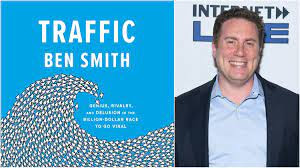
The Era of Social Media Journalism Is Over: A Conversation with Ben Smith
In the early 2000s, a significant media-business mistake emerged: the belief that website traffic is a commodity like oil, which would generate increased revenue as advertising improved. However, unlike other commodities, traffic lacked scarcity. The internet made traffic virtually infinite, posing challenges for new media-business models.
In this podcast, Ben Smith, former founding editor-in-chief of BuzzFeed, former media columnist for The New York Times, and author of Traffic: Genius, Rivalry, and Delusion in the Billion Dollar Race to Go Viral, discusses the rise and fall of new media like Gawker and BuzzFeed, the impact and consequences of megaplatforms like Facebook and Twitter, and the shifting landscape of contemporary journalism.
Smith examines the fluctuating trust in legacy news brands and the growing power of individual voices over faceless institutions, drawing parallels to developments in Hollywood, sports, and politics. Smith highlights the recent decline in both social media’s influence, and as a destination for news and information, and how this has led to more readers visiting homepages directly. He also emphasizes that conservative media outlets appear to have derived the most valuable insights from the social media era, adapting their strategies to thrive in the changing landscape.
Looking ahead, Smith suggests that journalism must help beleaguered consumers navigate the vast information landscape by providing context and a clear voice. He speculates that this may involve a return to some of the principles of print journalism — concision and an editorial perspective — while adapting to the digital era’s demands.
My conversation with Ben Smith:
A Conversation with Hernan Diaz about his Pulitzer Prize Winning Novel "Trust"
Hernan Diaz was just awarded the 2023 Pulitzer Prize for his novel, "Trust."
Last year, I had the opportunity to talk with Diaz about the book, his perspective on the Gilded Age, the persistent myths surrounding wealth, and the impact of these narratives on society as a whole. We also explored how the affluent can essentially "buy" their own reality amidst the enigmatic allure of money. Diaz's novel TRUST couldn't be more relevant to our current times. .
My conversation with Hernan Diaz:
Thursday, May 11, 2023
Are We Creating the Species That Will Replace Us?

As we hurtle towards a future increasingly intertwined with artificial intelligence (AI), what does this mean for society, for jobs, and for our security? Could AI, one day, be used maliciously, or in warfare or terrorism? And if these threats are real, how can we implement safeguards, and ensure the technology we create doesn’t turn against us?
At a time when AI is reshaping our reality and pushing the boundaries of what was once considered mere science fiction, this technological revolution demands our attention. On thisWhoWhatWhy podcast, I delve deep into the realm of AI and its potential impact on humanity with Matthew Hutson, a contributing writer at The New Yorker. Hutson’s work, featured in publications such as Science, Nature, Wired, and The Atlantic, reflects his background in cognitive neuroscience, and his emphasis on AI and creativity. His article “Can We Stop Runaway AI” appears in the current issue of The New Yorker.
At the heart of our conversation lies the concept of the technological singularity — a moment when AI surpasses human intelligence. Hutson details the role of machine- learning algorithms in AI’s remarkable progress, highlighting its capacity to continuously learn and improve. We also explore the growing trend of using AI to enhance AI itself, uncovering the implications and potential risks inherent in this self-improvement process.
My conversation with Matt Hutson:
Thursday, April 27, 2023
The Value of Killing Time: A Conversation with Sheila Liming
Struggling to find time for various tasks, our multi-colored Google calendars signify the complexity of the 21st century. The TV show Friends, popular across generations, nostalgically reminds us of simpler times in the early '90s without constant digital distractions.
This era allowed for unstructured, agenda-free time spent with friends, which now seems like a quaint memory. Nowadays, we hang out less frequently and with fewer friends, often while multitasking or participating in structured activities.
The once-common late-night dorm room hangouts have become nostalgic. Are we losing something valuable by giving up this unstructured time? Sheila Liming explores the potential disconnect between socializing and our ever-growing to-do lists in Hanging Out: The Radical Power of Killing Time.
My conversation with Sheila Liming::
Thursday, April 20, 2023
Cyber Weapons and a New Arms Race… Without Firing a Shot: A Conversation with Nicole Perlroth
As software takes over our lives — from hospitals to schools and even our national infrastructure — we’re facing an explosive wave of cyberattacks that could threaten our very existence.
The US — a hacker’s favorite playground — is a ticking time bomb, with 80 percent of its crucial systems tied to the internet and in private hands, with ZERO government control.
Join me in my WhoWhatWhy podcast for a conversation with New York Times cybersecurity reporter Nicole Perlroth. We are diving deep into her book This is How They Tell Me The World Ends, freshly updated with new revelations.
The US — a hacker’s favorite playground — is a ticking time bomb, with 80 percent of its crucial systems tied to the internet and in private hands, with ZERO government control.
Join me in my WhoWhatWhy podcast for a conversation with New York Times cybersecurity reporter Nicole Perlroth. We are diving deep into her book This is How They Tell Me The World Ends, freshly updated with new revelations.
My WhoWhatWhy conversation with Nicole Perlroth:
Wednesday, April 12, 2023
Science Is Simply Curiosity Writ Large: A conversation with Dr. Suzy Sheehy
We live in a world that's constantly evolving, driven by innovations in digital technology, AI, and space exploration. Yet, we often overlook the underlying physics that form the foundation of these advancements. The discoveries in physics of the past 120 years have truly shaped our world in ways that were once unimaginable. They were fueled by curiosity, serendipity, and the desire to ask "why?"
Dr. Suzie Sheehy, a physicist, science communicator, and academic has devoted her life to exploring the mysteries of our universe. In her groundbreaking new book, "The Matter of Everything," she delves into the incredible history of physics and the groundbreaking discoveries that have paved the way for the world we live in today.
My conversation with Dr. Suzie Sheehy:
Tuesday, March 28, 2023
How the Police Became Untouchable: A conversation with Joanna Schwartz
Recent police shooting victims Tyre Nichols and Anthony Lowe highlight the ongoing trend of officer impunity. The recent report on the Louisville police department and Breonna Taylor further underscores this issue. Greater accountability is necessary for police improvement, but the responsibility extends beyond law enforcement to our legal system, courts, and elected officials.
UCLA law professor Joanna Schwartz, an expert in police accountability and public interest lawyering, has has studies the depths of police misconduct and details it in her new work Shielded: How the Police Became Untouchable.
My conversation with Joanna Schwartz:
Tuesday, March 21, 2023
Dissecting the Silicon Valley Bank Debacle: A conversation with Dean Baker and Brad DeLong
It has been a momentous week for banks and markets. What some have dubbed an “extinction-level event” was, at its core, the failure of a couple of banks.
To help us put all of this into proper perspective, we are joined on this week’s WhoWhatWhy podcast by two distinguished economists, J. Bradford DeLong and Dean Baker.
DeLong served as deputy undersecretary of the treasury in the Clinton administration and is currently a professor of economics at the University of California, Berkeley. He is also the author of the substack Grasping Reality and the recently published book Slouching Towards Utopia: An Economic History of the Twentieth Century.
Baker co-founded the Center for Economic and Policy Research. His areas of research include housing and macroeconomics, intellectual property, Social Security, Medicare, and European labor markets. He has been credited as one of the first economists to have identified the 2007–08 United States housing bubble, and, in 2006, Baker predicted that “plunging housing investment will likely push the economy into recession.”
Together, they discuss the venture-capitalist libertarian overreaction to the event, as well as the way it has been massively misrepresented by all of the press, including the mainstream press.
They detail the differences between this event and the 2008–09 banking crisis, the power of contagion and rumor in the digital and social media age, and what actually transpired during the 36 hours the bank was shut down by the FDIC.
We discuss what this means for both small and regional banks, and for the “too big to fail” banks, which are now suddenly in favor.
While the whole story could be forgotten in a matter of weeks, the implications and downstream effects will be with us for quite some time.
My WhoWhatWhy conversation with Dean Baker and Brad DeLong:
Wednesday, March 15, 2023
Spies in Hollywood: A conversation with Jonathan Gill
The hacking of Sony Pictures back in 2014, by North Korea, made us all wonder about spies in Hollywood. Today, our paranoia tells us that the Chinese have spies everywhere. If they are checking on TikTok, they must be in Hollywood?
Well, during the Cold War, it turns out the studios were infiltrated with spies. One of those was a producer/director turned double agent named Boris Morros, and Jonathan Gill tells his story in Hollywood Double Agent: The True Tale of Boris Morros, Film Producer Turned Cold War Spy.
My conversation with Jonathan Gill:
Friday, February 24, 2023
A Real Life "Succession" Drama: The Story of Sumner and Shari Redstone
The constantly changing landscape of business, finance, entertainment, and medicine is influenced by technological advancements and cultural shifts, but those in power often resist change, especially if family is involved. The #MeToo movement and the ongoing streaming wars have transformed the entertainment industry.
The story of Sumner Redstone, a former movie theater magnate and owner of major media companies, his family, mistresses, and poor corporate governance, encapsulates these forces and is chronicled in James B. Stewart and Rachel Abrams' book "Unscripted: The Battle for a Media Empire and the Redstone Family Legacy."
My conversation with James B. Stewart & Rachel Abrams:
Monday, February 13, 2023
Joe Biden Fought To Get To The White House. Is He the President We Need Now?: My conversation with Chris Whipple
Joe Biden is the oldest President to take office in the past 234 years. He has a long public life, and has grown into the person and politician he is today. Biden was seen as the perfect antidote to Trump, but it is still uncertain if his preference for “normalcy” will enable him to be the 21st century President we need. Chris Whipple's new book, "The Fight of His Life: Inside Joe Biden's White House," explores this and more.
My conversation with Chris Whipple:
Labels:
Biden,
Chris Whipple,
jeff schechtman,
The Fight of his Life
Thursday, February 9, 2023
We Have No Democracy Without Good Citizens: My conversation with Richard Haass
A recent Gallup survey of American concerns showed that foreign policy is nearly at the bottom of the list, with inflation and prices near the top. Other high-ranking topics include the economy in general, immigration, crime and violence, race, the environment, and, topping the list, the proper role of government.
The fact is that none of these problems can be solved without a thriving, healthy democracy to address their root causes and work together to find bipartisan solutions.
That's why it becomes clear that our collective angst about all of these issues is really about whether we have a strong enough democracy, both locally and nationally, to solve anything.
Maybe that's why one of our most distinguished foreign policy experts has turned his attention inward, from understanding the world to trying to better understand the future of our place in it.
Richard Haass takes all this on in his new book, The Bill of Obligations: The ten habits of good citizens.
My conversation with Richard Haass:
Maybe that's why one of our most distinguished foreign policy experts has turned his attention inward, from understanding the world to trying to better understand the future of our place in it.
Richard Haass takes all this on in his new book, The Bill of Obligations: The ten habits of good citizens.
My conversation with Richard Haass:
Subscribe to:
Posts (Atom)


.png)