Showing posts with label cia. Show all posts

Tuesday, January 25, 2022

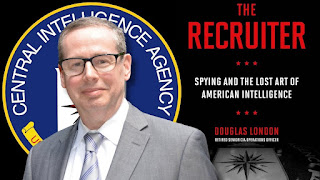
A Love Letter to Spy-craft: A Conversation With Retired CIA Officer Douglas London

For as long as humans have interacted with each other, spies in one form or another, have been with us. To quote the legendary John le Carre, “Jesus had only twelve friends over for dinner, and still one of them turned out to be a double agent.”

And while the nature of spy-craft has evolved, its fundamental missions remain the same. To gather actionable information. To get results.

So when we look at our failure to fully understand the Soviet Union during the Cold War, our inability to understand what to expect in Afghanistan, our shock with the recent Chinese hypersonic missile launch, and the lack of certainty as to what the Russians are planning in Ukraine, what does it say about the state of American intelligence?

Today we’re told that technology is the successor to human intelligence, but what has that wrought, and doesn't it still take humans, and their infinite capacity for suspicion, to understand and interpret that data?

Retired CIA officer Douglas London write about this in his new book The Recruiter: Spying and the Lost Art of American Intelligence 

My conversation with Douglas London:

Tuesday, May 12, 2020

The Truth About America's "Deep State"

Ever since the post-war years both fear and complexity have increased. Fear of the bomb, of communists, war, political assassination, and 9/11. Fear of technology, of the growth and concentration of business, and the growing increase in the size and power of government. Ideas that are often impossible to get one’s head around and to fully understand.

Much of our division today is about how we have navigated those fears and traumas. What has emerged it seems is two central narratives that have their origins early in the mid 20th century and are still evolving today. One that the blame lies with the military-industrial complex. With shadowy generals and CIA agents and covert operatives.

On the other side, the blame goes to governments. To faceless nameless bureaucrats. Educated elites who think they know better than what Nixon called the silent majority. The group t
hat Reagan wanted to shrink small enough to go down a bathtub drain. This became known as the “deep state.”

The battle between these two world views, one on the left today and one on the right provides much of fuel for our partisanship.

How we got here, and what the deep state really is, or even if there is one, is at the core of two time Pulitzer Prize winner David Rhode's In Deep: The FBI, the CIA, and the Truth about America's "Deep State"


Sunday, September 22, 2019

The CIA in the Post 9/11 World

Our attention span grows shorter while the events creating a whirlwind around the world, increase. N. Korea, Iran, China, Russia, Saudi Arabia, plus domestic turmoil is everywhere. In all of this, it’s easy to forget, just 18 short years after 9/11.

I often wonder how we’ll see this period that we are living through from the perspective of 50 years. But with respect to 9/11, the rearview mirror is starting to come into focus, as the objects are closer than they appear.

How the world and the US intelligence has transformed as a result of those events impacts everything we do today and is worth examining with this renewed hindsight.

In that sense, my guest Philip Mudd was present at the creation. He was in the White House as events of 9/11 unfolded and now he’s writing about them in ways that may inform or future. His recent book is Black Site: The CIA in the Post-9/11 World.

My conversation with Philip Mudd:


Monday, March 13, 2017

A Real Life Spy Who Came In From The Cold

Every institution of government today is in chaos. Departments are unstaffed, the State Department is hollowed out, cabinet secretaries are either apologizing for themselves or the President, or they are traveling the world trying to reassure allies and adversaries.

But few institutions are in the kind of direct conflict, almost open hospitality, with the administration that the intelligence community and the CIA are. From his botched initial visit to Langley, to six am tweets, not since Kennedy have we had a President in open warfare with his intelligence community

Joining me to talk about all of this is John Kiriakou.

John Kiriakou, was a 15 year CIA veteran, where he rose through the ranks to the very highest levels of the agency. He was the first one in the intelligence community to expose the CIA’s use of torture. As a result he became on of very few American ever prosecuted under the Espionage Act. He was considered a whistleblower and served twenty-three months in federal prison

He is author of three books, his most recent is Doing Time Like A Spy: How the CIA Taught Me to Survive and Thrive in Prison

My conversation, on Radio WhoWhatWhy, with John Kiriakou:


Tuesday, November 25, 2014

Valerie Plame's BURNED

We live in an information age. The goal of virtually every App on our phone, and most websites, is perfect information; about the world, about our neighbors, about our friends and about ourselves.

So how is it, that with all this information, the world is so much more dangerous. That secrets are sometimes so much deeper, that bad actors, and even good ones turned bad, can often outsmart, out run and out maneuver the CIA, the very agency designed to ferret out those secrets and keep us safe.

Even as the very first tenants move into the new World Trade Center, we’ve come to appreciate the importance and value of human intelligence. But those that engage in it are often at risk both from their enemies and their friends.

Few understand this better than former CIA operative Valerie Palme. Her life and career was derailed, in public view, as much by friends as by her enemies. Valerie Plame’s career continues through the work and efforts of her fictional alter ego Vanessa Pierson.

Pierson made her debut in Blowback, and now she’s back in Burned.

My conversation with Valerie Plame:


Bookmark and Share

Thursday, July 10, 2014

A Spymaster's Story

It’s easy to forget that long before the intelligence failures of 9/11, the misinformation about Iraq's WMDs and what has become almost the militarization of the CIA, the agency had done well as the bulwark of American Intelligence efforts in the Cold War and in helping to define America's place in the world.

Perhaps there is no better way to look back at that effort, than through the lens of the CIA’s most Zelig like character, Jack Devine.

Devine served eleven Directors of the CIA. He was there when Allende fell in Chile, in the effort to aid the Mujahedeen against the Soviets in Afghanistan, in the morass of Iran/ Contra, in the hunt for Pablo Escobar, during the Haitian coup in 1991, and he ultimately served as leader of the Directorate of Operations, the nerve center of America’s covert operations worldwide. He tells his fascinating story in Good Hunting: An American Spymaster's Story

My conversation with Jack Devine:


Bookmark and Share

Wednesday, June 4, 2014

Tinker, Tailor, Hacker, Spy

Creative destruction, change, automation, the Internet of everything. These are all the issues that seem to impact every aspect of modern life. And whether you believe these things are good or bad, is not relevant. What is relevant is that they are happening everywhere, including in the context of American spycraft and diplomacy and in institutions like the CIA.

In a world where quick and nimble and of course secrecy are often the objective best practices, spycraft today has gotten more mired in the institutional morass of every bigger bureaucracy.

That’s the underlying backdrop for David Ignatius in his latest spy thriller, The Director.

My conversation with David Ignatius:


Bookmark and Share

Friday, January 10, 2014

Is torture ever justified?

Back in the dark days of the Cold War, John le Carre published The Spy Who Came In From The Cold.
It cast a light, as only fiction sometimes can, on covert actions that are not a clear choice between good and evil, but one where the methods that western intelligence would use, disturbingly resembled those used by their opponents. The distance between us and them became blurred. It exposed the Cold War not as a battle between light and darkness, but a place where both sides meandered in the twilight of moral ambiguity.

In the days following 9/11 we as a nation, our policies and our intelligence service, the CIA, would again begin to blur those lines.

At the same time, the actions that the President would arguably take, were reminiscent of Richard Nixon's comments in his famous interview with the late David Frost where he said, talking about Watergate at the time, "if the President does it, it means it's not illegal."

John Rizzo as CIA General Council, was at the center as that post 9/11 storm, as he was at the center of everything the CIA did for 34 years. He takes us through the history in Company Man: Thirty Years of Controversy and Crisis in the CIA.

My conversation with John Rizzo:


Bookmark and Share

Wednesday, October 9, 2013

The spy who was forced in from the cold

Spies and covert agents are, by their very nature required to live lives of secrecy. So when some spies, for whatever complicated reasons, become household names like Aldrich Ames, Kim Philby, or Robert Hanssen, it's a big deal.

In 2003, the outing of covert CIA operative Valerie Plame, by columnist Robert Novak, brought an end of her CIA career. But it also brought all of us, in ways not seen since the Cold War, into better harmony with the symbiotic relationship that exists between politics, espionage, and government bureaucracy.

The outing of Plame triggered a political scandal that would truly make her, the spy who came in from the cold. Now 10 years later, Valerie Plame is back, but this times masquerading as Vanessa Pierson, in her novel Blowback

My conversation with Valerie Plame:


Bookmark and Share

Wednesday, June 26, 2013

I Spy

Certainly the subject of spying and secrets is front and center today.  For Scott Johnson it almost always was.

It has been written that the sins of the father shall be visited upon their sons.  In a broader sense it's clear that often, as we try to reach escape velocity from our fathers, we end up becoming just like them.

Journalist and long time Newsweek foreign correspondent Scott Johnson, tells such a story in his memoir The Wolf and the Watchman: A Father, a Son, and the CIA.

My conversation with Scott Johnson:


Bookmark and Share

Monday, May 6, 2013

If you are caught or captured the secretary will disavow any knowledge of your actions.....

We all grew up with our own impressions of what covert actions were all about. John le Carre talked about the moral twilight in which these activities operated. But never has that line between military, espionage and covert actions been more blurred than it is today. From 9/11 to the bin Laden raid, the CIA has been front and center as the agency of first resort, to carry out difficult and controversial missions.

Now Pulitzer Prize winning journalist Mark Mazzetti lays bear much of this activity in The Way of the Knife: The CIA, a Secret Army, and a War at the Ends of the Earth.

My conversation with Mark Mazzetti:


Click here to listen on your iphone or ipad

Bookmark and Share

Tuesday, May 29, 2012

The real Dark Arts

From Mati Hari, to Nathan Hale, to Herbert Philbrick; each is a chapter in the pantheon of espionage. Each had what George Smiley called "the ability to survive by virtue of an infinite capacity for suspicion."

In the modern day world of espionage, counter-terrorism and post cold war engagement, Henry Crumption stands astride that list. He knew he wanted to be a spy from the age of 10. He knew that sometimes you had to do things in order to find out the reason from them. From what he tells us, he seems to innately understand, from his early missions in Europe and Africa, to his leadership of the CIA war against the Taliban in 2001, that sometimes our actions are question and not answers. But he was always guided to navigate by the true north of his moral compass. His new book The Art of Intelligence: Lessons from a Life in the CIA's Clandestine Service, he sets the stage for a new kind of espionage and in fact a new geopolitical view of intelligence.

My conversation with Ambassador Henry Crumpton:


Click here to listen on your iphone or ipad

 Bookmark and Share

Thursday, July 28, 2011

The Interrogator

Espionage by its very nature exists in a kind of moral twilight. The decisions that spies often have to make may be repugnant to their own moral codes or sensibilities, but consistent with a view of the greater good for country or society. But happens when this circle cannot be squared? When the mission simply cannot be justified within any moral framework and in fact, seems both wrong and inconsistent with the greater societal good? Then, more then ever, it takes a profile in courage to rise, to speak up and to do better. That is precisely what twenty-three year CIA case officer Glenn Carle had to face. He details this most important mission of his career in The Interrogator: An Education

My conversation with Glenn Carle:


Click to listen on your iphone or ipad

Bookmark and Share

Sunday, November 22, 2009

Fourty-Six years and we still are seeking the truth


Forty-six years after the murder of John F. Kennedy new information continues to come to light.  The link between a secret coup planned by JFK and Robert Kennedy against Cuba and their personal war against Mafia all culminated in a perfect storm, as Kennedy's Cuban exile aid, who would go on to become one the Watergate burglars, Bernard Barker, sells out the JFK coup plan to long-time mob bosses Santo Trafficante and Carlos Marcello.

If it sounds hard to believe, historian Lamar Waldron lays it all out in 944 pages of painstaking detail in his book Legacy of Secrecy: The Long Shadow of the JFK Assassination.

My two part conversation with Lamar Waldron:

Part One:


Part Two:
Bookmark and Share