Tuesday, January 25, 2022

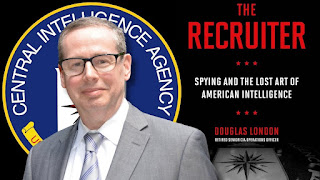
A Love Letter to Spy-craft: A Conversation With Retired CIA Officer Douglas London

For as long as humans have interacted with each other, spies in one form or another, have been with us. To quote the legendary John le Carre, “Jesus had only twelve friends over for dinner, and still one of them turned out to be a double agent.”

And while the nature of spy-craft has evolved, its fundamental missions remain the same. To gather actionable information. To get results.

So when we look at our failure to fully understand the Soviet Union during the Cold War, our inability to understand what to expect in Afghanistan, our shock with the recent Chinese hypersonic missile launch, and the lack of certainty as to what the Russians are planning in Ukraine, what does it say about the state of American intelligence?

Today we’re told that technology is the successor to human intelligence, but what has that wrought, and doesn't it still take humans, and their infinite capacity for suspicion, to understand and interpret that data?

Retired CIA officer Douglas London write about this in his new book The Recruiter: Spying and the Lost Art of American Intelligence 

My conversation with Douglas London:

Thursday, January 13, 2022

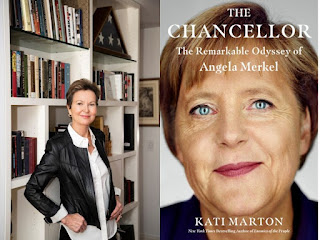
Politics Without Celebrity - Kati Marton's The Chancellor

Imagine a political leader that is not about celebrity or attention? In a time when we have elected a reality show star as President, when celebrity politics is the lifeblood of the American political class, it’s hard to imagine a politician or world leader whose life is private; who keeps their own counsel, who listens first, who shuns celebrity, and yet proves powerful as a leader.

Such was Angela Merkel, who served for 16 years as German Chancellor. Its first and only woman Chancellor, and without questions the glue that held parts of the world and certainly the Western Alliance together for many years.

What can we all learn from this Greta Garbo of geopolitics? To find out we have to dip into Kati Marton’s new biography of Merkel,  The Chancellor: The Remarkable Odyssey of Angela Merkel 

My conversation with Kati Marton:

Tuesday, January 4, 2022

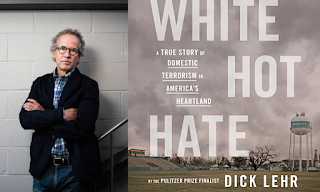
January 6th Was a Rallying Point For White Hot Hate

As we witnessed on January 6th, the level of hostility and anger awash in the country today has real consequences. Demagogues and hateful rhetoric have real power And while some argue that history teaches us that such rage burns white-hot and then dies out, what happens while it's burning hurts people and sometimes changes nations.

It’s really no different than when we see protestors in other countries attacking America, burning the American flag, and taking Americans hostage.

In a world moving at the speed of light, tribalism, and hatred for the other, for those that are different, are everywhere. Even in a small Kansas town,

That is the story that Dick Lehr tells us in White Hot Hate: A True Story of Domestic Terrorism in America’s Heartland.

My conversation with Dick Lehr:

Monday, December 27, 2021

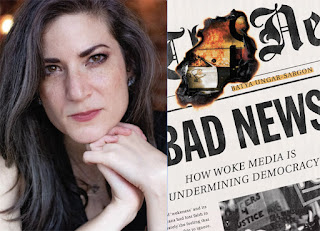
How Fame, Fortune and Education Ended Objective Journalism: A conversation with Batya Ungar-Sargon

Too often when talking about the media and journalism we engage in a board discussion of ideas, policy, and how the levers of power really work


What we often forget is that all of this is made up of people. People who bring to the exercise of power and of reporting on it, their own values, education, and personal history.

In that fact lies much of what is wrong with the media today. It's how we lost sight of the power of class in journalism, why we’ve tried to bury class differences inside racial differences and wokeness.

If all of this sounds too nuanced, Batya Ungar-Sargon, the deputy opinion editor of of Newsweek, helps us understand how it’s shaping our media and democracy in her new work Bad News: How Woke Media Is Undermining Democracy


My conversation with Batya Ungar-Sargon


Wednesday, December 15, 2021

The Modern Era of Television Begins with HBO: A Conversation with James Andrew Miller

The link between what we watch in movies and on television, and the business, the money and the people behind it, are inseparable. Business decisions impact and shape what we see, just as one hit can change the finances of an entire company or industry.

The story of HBO, and the way in which it disrupted television, beginning back in the early 1970s, is perhaps the penultimate example.

Just as today we are going through a sea change with respect to how stories are delivered to us, HBO was the creative destruction of its day. Its motto, like Facebook, could easily have been “move fast and break things.”

And just as HBO disrupted television. Blockbuster would eventually disrupt HBO, Netflix would disrupt Blockbuster, and technology and streaming would disrupt everything. But in many ways the story all starts with HBO.

That’s the story that James Andrew Miller tells in his comprehensive and entertaining oral history Tinderbox: HBO's Ruthless Pursuit of New Frontiers 

 My conversation with James Andrew Miller:

Tuesday, December 7, 2021

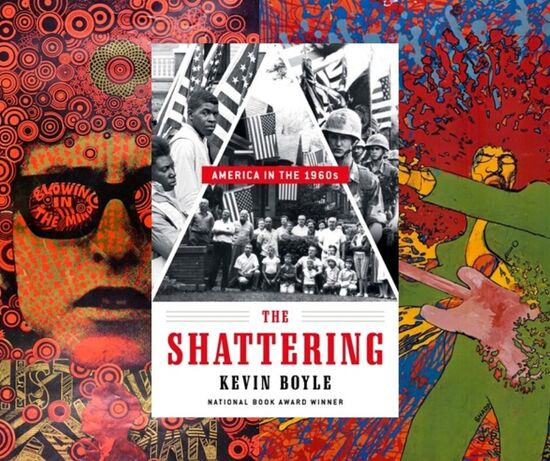
The Shattering: America in the 1960's: A Conversation with Kevin Boyle

Think of all that has changed as a result of startups and creative destruction. Nothing is the same as it was because of the sometimes revolutionary ideas of entrepreneurs.

In a similar way the 1960s were a time of creative destruction for America and the world. The post war paradigms that had shaped the country through the late 40’s and early 50’s were shattered. And just as today we are struggling, socially, politically and economically to come to grips with the our technology disruption, on a grander scale we are still trying to come to grips with the social and political shattering of the 60’s

We explore this with National Book Award winner Kevin Boyle, whose new book is The Shattering: America in the 1960s 

My conversation with Kevin Boyle:

Wednesday, December 1, 2021

The Post-Pandemic Normal Will Never Be the Way It Was

Everyone desperately wants to know what the post-pandemic world will look like. Adam Tooze has been thinking hard about it and he thinks he knows. 

Comparing the US experience to China’s, he notes how cultural and political differences have determined successes and failures in dealing with the unprecedented challenge of COVID-19. Tooze argues that, like soldiers returning from mortal combat, we are suffering from a kind of national — and even global — PTSD.

Tooze, Columbia University history and economics professor is the author of Shutdown: How Covid Shook the World's Economy.

My WhoWhatWhy conversation with Adam Tooze::


Tuesday, November 30, 2021

Has the Death of Faith Made Us More Tribal?

IThe Universe Is on Our Side: Restoring Faith in American Public Life Bruce Ledewitz argues that there has been a breakdown in American public life that is beyond issues or politics. He argues that America is living with the consequences of the death of faith, which Nietzsche presumed would be momentous and irreversible.


According to Ledewith, America's future requires that we begin a new story by asking a question posed by theologian Bernard Lonergan: Is the universe on our side?

My conversation with Bruce Ledewitz:


Friday, November 19, 2021

The Rise and Fall of the NRA and What it's Cost Us: A Conversation with Tim Mak


For the past 40 years, the debate about the proliferation of guns in America has revolved around the NRA. All public policy has been shaped and driven by the political influence of the NRA. Few if any lobbying groups in American history have ever been so powerful for so long.

But how did this power evolve, and what led to its downfall. What was behind its scorched earth “never give an inch” philosophy and was it simple greed and old fashioned corruption that brought it down?

Four years of research have given my guest NPR Washington investigative correspondent, Tim Mak some answers to these and many other questions. He details them in Misfire: Inside the Downfall of the NRA 

My conversation with Tim Mak:


Thursday, November 11, 2021

China: Enemy or Competitor?


Elbridge Colby, is co‑founder and principal of The Marathon Initiative. He served as deputy assistant secretary of defense for strategy and force development from 2017 through 2018, and led the development of the 2018 National Defense Strategy.

In his recent book, The Strategy of Denial: American Defense in an Age of Great Power Conflict, In it, Colby addresses our relationship with China in brutally frank terms

Some of the questions he sets out to answer:

Do we need a grand strategy for China, similar to the Cold War policy of “containing” the former Soviet Union?

To counter China’s military strength, do we need to remove our troops from Europe and the Middle East, since we are no longer realistically capable of operating in three theaters?

What should we do if China moves on Taiwan?

What role would our Western allies play if we confronted China?

In a US/China conflict, would other Asian nations side with the US or make their own deal with China?

Has US credibility in Asia been irreparably harmed by our Middle East performance?

If China is politically dominant in Asia, does that mean they would also dominate the world economy?

What might a war with China look like?

My WhoWhatWhy.org conversation with Eldridge Colby:


Tuesday, November 2, 2021

How the Index Fund Changed Finance and Why It's Still So Powerful Today


Never have so many individuals been actively engaged in trading in the equity markets. Robin Hood, Reddit, meme stocks, crypto, blockchain are the language of a whole new world of mostly young traders. And most of them will lose money.

They think they can outperform markets that have long humbled the smartest guys in the room.

So back in the early seventy, a group of those guys got together to imagine and evolve a way to passively participate in the markets. Long before information about the markets had been democratized. Long before we checked our portfolio every-time we checked our phone, the idea of passive index funds would take hold.

And even in our hyperbolic financial world today, they are still going strong. In fact, they are so powerful, they alone can move markets.

What this all means for markets and economics is worth examining. To do so I’m joined by Robin Wigglesworth, the global finance correspondent at the Financial Times and the author of Trillions: How a Band of Wall Street Renegades Invented the Index Fund and Changed Finance Forever 

My conversation with Robin Wigglesworth:


Thursday, October 28, 2021

Dirty, but Essential Work: A Conversation with Eyal Press


Workers left their jobs at a record pace in the past few months. They left because of health concerns, child care issues and because, post pandemic, they did not want to return to what they saw as rotten jobs. Jobs that were ethically and morally challenging.

The pandemic has brought new light to these workers. Often, in what has been called essential work. It has highlighted and personified the work we often don’t see, but that we all rely on for keeping the wheels of society working.
 
Studs Terkel said that “work is about a search for daily meaning as well as daily bread, for recognition as well as cash, for astonishment rather than lethargy; in short, for a sort of life rather than a Monday through Friday sort of dying." And yet for millions of workers this dying that Terkel talked about, is what they face, day in and day out.

We can't imagine what it does to them, but also what it does to our society. This is what Eyal Press examine in Dirty Work: Essential Jobs and the Hidden Toll of Inequality in America.

My conversation with Eyal Press:

Monday, October 18, 2021

Looking for America: My Conversation with Evan Osnos

Without comparing one historical era to another, suffice it to say that we live in a nation filled with anger, despair and at best anxiety. Our ideological, economic and cultural divisions have infected every fiber of the public square. And all of this is happening amidst loss of faith in our once valued institutions, both public and private. A loss of faith in facts and truth, and in the fundamentals founding principles of self governance of fairness and selflessness.

But we didn’t get here overnight, nor did some external forces (no not even Donald Trump) create this environment.

NY staff writer Evan Osnos went, like Simon and Garfunkel, looking for America. He looked in the mix of places he knew best, Greenwich, Connecticut where he grew up, Clarksburg West Virginia where he worked as a young reporter, and Chicago, the very definition of urban America.

The result of that effort is his new book Wildland: The Making of America's Fury 

My conversation with Evan Osnos:

Friday, October 8, 2021

What Is The Future of Transportation? Hint...It's Not A Better Car

A recent survey showed that the reason people are reluctant to go back to the office has nothing to do with COVID, but with their commute. It’s not the office they object to, it’s getting there.

Particularly in places like New York, San Francisco, Atlanta and Washington DC, commute times have exploded in recent years.

Perhaps when the dust settles, perhaps what we will have changed as a result of a year at home, is less how we work, and more how we move about.

But will we ever give up our love affair with the automobile? Will new generations approach transportation in a new way? Are flying cars ever going to be a thing? And what can we learn from the last great inflection point as we went from the horse to the car?

All of this is part of Tom Standage’s new book, A Brief History of Motion: From the Wheel, to the Car, to What Comes Next.

My conversation with Tom Standage My conversation with Stephen Kurczy:

Thursday, September 30, 2021

No Cell Service, No Technology and Electrosensitives Everywhere: Stephen Kurczy Talks about "The Quiet Zone"

I suppose even the most ardent technologists have at times wanted to get off the grid...usually that urge doesn't last long. But for the people of Green Bank, West Virginia, it’s an ongoing state of affairs. 
The only town that is designated as a national radio quiet zone, is actually not all that quiet. It seems that just as before technology subsumed us, people do find other ways to communicate, and to get into all sorts of trouble. 

The story of Green Bank and its people is where my guest Stephen Kurczy takes us in The Quiet Zone: Unraveling the Mystery of a Town Suspended in Silence 

My conversation with Stephen Kurczy:

Saturday, September 18, 2021

As You Look At The Emmys, Remember That It Is Only Streaming and Entertainment That is Bringing the World Together

It wasn’t very long ago that to see a foreign language film, you wound up in the smallest theater in the multiplex or a little art theater somewhere in a college town...or you lived in New York or San Francisco or Boston. But like everything else, creative destruction has done its job. Streaming and the long tail of the internet has moved to supplant cable, movie theaters, broadcast television, and even the English language as the talisman of all of our entertainment. 
Even amidst the bifurcation and division in both the US and the world, filmed entertainment seems to be one of the few things bringing the world together. Suddenly at our fingertips is programming made everywhere. And rather than looking at it as an oddity reserved only for a few cinephiles, it’s now working its way into the mainstream of all of our living rooms.

Is this just a temporary blip due to COVID and the pandemic, or has global entertainment undergone a tectonic shift that both reflects and might reshape our culture? We’re going to talk about this with Scott Roxborough. 

Scott is an international reporter covering film and television and music. He reports on entertainment from Europe for the Hollywood Reporter, Billboard, and German TV, and wrote a seminal article for the Hollywood Reporter dealing with this subject. 

My WhoWhatWhy.org conversation with Scott Roxborough:


Tuesday, September 14, 2021

The News About the News: A conversation with Martha Minow

For journalism, it may be the best of times and the worst of times. On the one hand, the national media is more vibrant than ever. The New York Times, The Washington Post, and The Wall Street Journal, as well as broadcast and cable news networks are thriving. For these outlets, the transition to digital has been painful, but successful and is still ongoing.  It was recently announced by CNN and NBC News that they would be moving to a streaming model.
Today, The New York Times derives more than sixty percent of its revenue from digital subscriptions. Recurring revenue models are driving the success of independent and specific news outlets and individual journalists on Substack and similar platforms that are thriving. While romantics rap quixotic about the 23 newspapers that once were available in New York City, websites and Twitter have now subsumed that. New sites start up regularly with lower barriers to entry and what some argue is a greater democratization of information.

For local news, however, the story is different. For what’s happening in your neighborhood, your school board, your city council, is a very different story. Thousands of local newspapers and local radio stations have shut down. The economics of the enterprise has proven to be unsustainable, and even large regional papers in places like LA, Chicago, and Miami have proven to be problematic. While many of the best of these papers have been stripped and plundered by hedge funds, let’s also remember that many were acquired by the hedge funds out of bankruptcy.

All of this begs the question as to whether our political, cultural, and social divide stems from the top as is assumed, or whether the hollowing out of news in our communities, something that should be bringing us together, is at the heart of what’s wrong? If so, does the government have a role to play in fixing that effort? Is the problem with the product, with the public, or as it is often so easy to do, should we just blame social media?  Understanding this is the work that Martha Minow takes on in Saving the News: Why the Constitution Calls for Government Action to Preserve Freedom of Speech

My WhoWhatWhy.org conversation with Martha Minow:


Saturday, September 4, 2021

The Myth of "Nobody Saw it Coming"

The more we know about disasters, the more we realize that most were preordained. Covid 19 or Katrina, the current fires in California or the deep freeze this past winter in Texas. None of them were what we would call Black Swan events.

We are certainly, because of climate change, complexity and complacency, going to be experiencing more such events, we had better become much better at disaster preparedness.

If we know these disaster events are coming, how can we get better at dealing with the consequences? Fire season is yet to reach its peak this year, hurricanes are starting early and we know that more infrastructure and buildings will collapse.

Therefore, the area of disaster management should be one of our number one priority, just as it has been for my guest Dr. Samantha Montano, the author of Disasterology: Dispatches from the Frontlines of the Climate Crisis 


Tuesday, August 31, 2021

Democracy Dies In The Chaos of Competing Truths: A Conversation with Robert M. Smith


Survey after survey shows that trust in the news media is at an all time low. And it’s not just the left/right divide.

A recent study by the American Press Association reveals that not all Americans universally embrace core journalistic values, and that the trust crisis might best be understood through people’s moral values even more than their politics.

When journalists say they are” just doing their jobs,” the problem is many people harbor doubts about what that job should be.

Couple this with an ever changing media landscape driven by economics, the political bifurcation of news via the long tail of the internet, the news/entertainment nexus, celebrity culture, and now cancel culture, and it makes for an environment that has very little to do with getting at the truth. Maybe democracy dies not in darkness, but in the chaos of competing truths.

This is the world that long time journalist Robert M. Smith explores in Suppressed: Confessions of a Former New York Times Washington Correspondent.

My conversation with Robert M Smith:

Tuesday, August 24, 2021

America Is No Longer A Serious Nation: My conversation with Tom Nichols:

Almost everywhere in the world, liberal democracy is, if not under siege, or at least being tested. Only in rare historical times have would-be autocrats found such fertile ground. But why? 

The world's and yes, America’s standard of living is rising overall. As Steven Pinker has pointed out, crime and violence is down. The census tells us that diversity is naturally occurring and technology has made life easier. While we are not perfect, the arc of history is bending towards justice. And yet we’re angrier, more frustrated, and more willing to buy snake oil than ever before. 

We’re quick to cast blame. Quick to believe anything that fits our preconceived narrative, and each side has its Boogeyman and Straw-man. But what if the answer to these problems is not out there? What if Cassius was right? — that the fault is not in our stars, but in ourselves. 

This is what Tom Nichols explores in his new work Our Own Worst Enemy: The Assault from within on Modern Democracy 

My WhoWhatWhy conversation with Tom Nichols: